Marc Rodin
The Day of the JackalMarc Rodin is the exiled Secret Army Organisation’s operations chief, a leader whose combination of ideological rigidity and practical intelligence makes him the architect of the plot to hire The Jackal to assassinate Charles de Gaulle. His defining decision is to abandon the organisation’s compromised network of known militants in favour of an outsider; his later inability to recall that outsider turns a carefully reasoned plan into an operation he cannot stop.
Identity and Background
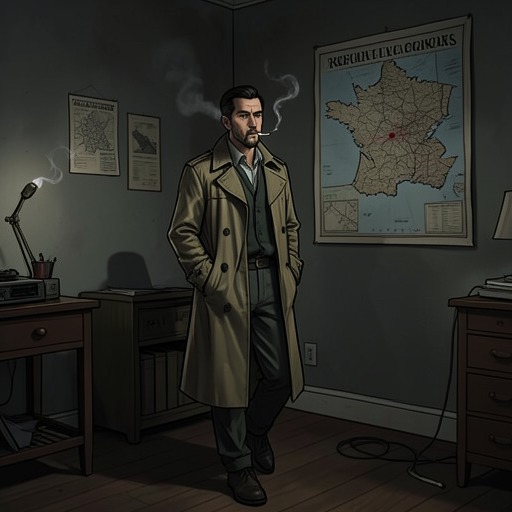
Rodin’s political commitment is absolute when he confronts what he regards as the honour of the Army and the future of France. His response to Jean-Marie Bastien-Thiry’s execution makes that allegiance immediate: hearing the news broadcast in a small hotel room in Austria, he switches off his transistor radio, leaves his breakfast almost untouched, and watches the late spring still holding the snow-covered landscape. His muttered anger is directed at Charles de Gaulle, the French Government, and the SDECE Action Service. The scene places private grief and political hatred together, but Rodin’s importance lies in what he does next: he turns the shock of the execution into a problem to be solved.
Rodin had survived the collapse of the 1961 mutiny with 120 officers, non-commissioned officers, and enlisted men still under his command. His unit contained a high proportion of veterans of the Indochina and Algerian campaigns, a history that helped distinguish it from other parts of the mutinous force. With the other putschists, his remaining men formed the Secret Army Organisation, pledged to overthrow de Gaulle. As the French settlers fled and the organisation’s campaign of revenge gave way to defeat and exile, its leaders became targets of the Gaullist authorities.
In exile, Rodin first served as deputy to Antoine Argoud, becoming operations chief in the winter of 1961. Argoud supplied the flair and inspiration for the organisation’s offensive; Rodin supplied organisation, cunning, and practical judgment. The narrative stresses that he was more than a tough fanatic. The son of an old cobbler, he had received neither a formal education nor the development that army service might have provided, but had cultivated his intelligence independently. His political convictions could make him bigoted; faced with a practical obstacle, however, he could concentrate on it logically and pragmatically.
From Execution to a New Plan
On 11 March, Rodin applies that practical cast of mind to the problem of killing de Gaulle. The earlier failures of the Petit-Clamart assassination attempt and the École Militaire assassination plot have made the task harder: the President is protected by concentric layers of security, and simply finding a willing killer is not enough. Rodin spends two hours chain-smoking at a window, listing the obstacles and testing possible schemes against them. Each plan initially seems feasible, then fails under his scrutiny. The central problem is security.
The danger is not merely the visible police presence. Infiltration of the Secret Army Organisation by the SDECE Action Service has become more extensive, and the recent abduction of Argoud demonstrates how far the service is prepared to go to reach and interrogate its leaders. At the same time, Rodin’s briefcase records an organisation short of money and losing support, membership, and credibility. The execution of Bastien-Thiry further damages morale. Its best-known militants are recognisable to police and public alike, while a complicated plan requiring coordination among many groups would risk exposure long before an assassin reached de Gaulle.
Rodin’s answer is to seek a man who is not known. He considers men already available to the organisation and understands that each has a substantial file in French police headquarters. The solution that survives his examination is an outsider: someone outside the compromised network, unknown to the Secret Police, and capable of carrying out the assassination without depending on the organisation’s familiar personnel. Rodin presents this conclusion to Montclair and Casson, who move from astonishment to comprehension. He then explains that the idea of hiring a professional mercenary assassin first came to him on the day he heard of Bastien-Thiry’s execution. He has been searching since the middle of March and has prepared three dossiers, ranked by preference in case his first choice refuses or cannot take the job.
The Contract and Its Machinery
Rodin’s choice of an outsider is not a retreat from planning but an attempt to make planning less visible. He wants an assassin who can bypass the network of spies and informers, depriving the Secret Police of advantages built around the organisation’s known members. His proposal treats secrecy as the essential condition of the operation: the assassin’s usefulness depends not only on skill but on being unfamiliar to the authorities and able to act without a large, vulnerable supporting apparatus.
The practical arrangements reveal how Rodin combines personal authority with the organisation’s remaining resources. At the chiefs’ guarded hotel, mail for him and his colleagues is kept in a steel case chained to Viktor Kowalski’s wrist; the case and chain can be unlocked only with keys held by Rodin. Later, after a message confirms that the combined Secret Army Organisation accounts in Switzerland contain more than $250,000, Rodin writes instructions to transfer that sum to the hired assassin. He expects a further $250,000 to become available after de Gaulle’s death, reasoning that extreme-right industrialists and bankers who had previously withheld more money would then compete to support the soldiers expected to become France’s new rulers. The expectation is his calculation, not a payment shown as completed.
Casson challenges the timing. The three leaders have promised their Englishman a contact in Paris who can supply current information about de Gaulle’s movements and any changes to his security routine. Informing the assassin that the money is being transferred could encourage him to act before that intelligence is ready; Casson argues that the information may make the difference between success and another failure. Rodin’s plan therefore depends on more than the contract: it also requires communication and timely intelligence, the very links that make the operation vulnerable to exposure.
Exposure and Loss of Control
A later police inquiry into the hotel where Rodin and his colleagues had stayed produces one trace of Rodin’s own movements. Investigators show photographs of Rodin, Montclair, and Casson to the clerk at the Pension Kleist. After being asked to check the register, the clerk recalls Rodin as a man who booked a room under the name Schulz on June 15, held what appeared to be a business conference, spent the night, and left the next day. The recollection is uncertain in its identification of the visitors, but it supplies the investigators with a dated alias and a recorded stay.
The more decisive blow comes through Kowalski. When a message reaches Rodin that the SDECE has learned of The Jackal, he wakes at once, reaching for the gun beneath his pillow before recognizing the former legionnaire who has brought it. His first reaction is anger at Kowalski. At first he had assumed that the missing man had deserted, as other members of the weakening organisation had done; he had believed Kowalski would remain loyal. Now he understands that the former subordinate has apparently returned to France or been abducted in Italy and has spoken under pressure.
Rodin reconstructs how the assassin’s code name could have reached the authorities. When he and The Jackal parted, Rodin had greeted the Englishman using the code name in Kowalski’s presence. He concludes that Kowalski could not have supplied the assassin’s real name, which only Rodin, Montclair, and Casson knew, but the confession has still exposed enough: the meeting, the hotel, the man’s appearance, and the code name. The authorities can infer that the blond Englishman is a professional killer. Rodin expects the security around de Gaulle to tighten and the President’s public engagements and exits to disappear, closing the opportunities on which an assassination depends.
Rodin resolves that The Jackal must be warned and instructed to halt. He sends a bodyguard to make the call, but the attempt to reach the assassin receives no reply. When Casson and Montclair ask what can be done, Rodin has no effective answer. He cannot recall a man whose location and intentions are unknown, and using their clandestine contact, Valmy, to relay an order could expose that contact as well. Rodin acknowledges the professional difficulty of standing down an operation he planned himself, but the practical fact is harsher: The Jackal has gone, is acting alone, and can no longer be stopped by his employer.
Narrative Role
Rodin’s plot-making and the police manhunt are built around opposing uses of information. He selects an outsider because the organisation’s known members have become legible to the authorities; later, one careless exchange and Kowalski’s confession make even the outsider’s alias and connections usable clues. The investigation’s records and reports gradually turn what Rodin hoped would remain invisible into a traceable chain of hotel stays, names, and contacts. The contrast gives his intelligence a limit: he can identify the weakness in the old method and design a different one, but cannot control what happens once the plan depends on people and communications beyond his reach.
His arc ends not with a reported change of allegiance or a demonstrated cancellation, but with the collapse of command. Rodin remains committed to the assassination and recognizes his responsibility not to send a man into a mission he believes impossible; nevertheless, the very independence that made The Jackal attractive has made recall impossible. Rodin is thus both the strategist behind the threat to de Gaulle and one of the first characters to understand that the operation has escaped its author.